Taishō and Shōwa era War Medals: A Comprehensive Guide for Collectors
This in-depth guide is meant to show what Taishō and Shōwa era war medals look like, the types of boxes in which they were given, if a washi paper* (rice paper to protect the box) and a certificate (kishō shōsho) is part of a complete set, and what they were awarded for. The pictures shown are from my personal collection and the internet, providing a comprehensive guide of all the medals belonging to the Taishō and Shōwa era in chronological order.
If kanji numerals are used, I refer to the Sacred Treasure guide for their interpretation, as they are explained there. Also the different two script forms (kyūjitai and shinjitai) you can encounter in researching Japanese militaria.**
* See The 1937-45 China Incident War Medal, to know how a washi paper look like
**All kanji is read from right to left.
The 1914-20 First World War Medal
The first medal is the Taishō First World War Medal (1914–1920). This medal was established following the First World War (1914–1918), as well as Japan’s Siberian intervention against the Soviet Bolsheviks, known as the “Japanese intervention in Siberia,” which lasted from 1918 to 1922.
The medal was instituted on 6 November 1915 by Imperial Edict No. 203 (Taishō 3 / 大正三年). It is important to note that this medal exists in two versions: an earlier type (War Medal 1914–15) and a later type (War Medal 1914–20), which will be examined in greater detail in the medal analysis section. Both versions were minted in Osaka, with approximately ~50.000 – ~70.000 of the earlier type and around ~150.000 – ~180.000 of the later type produced.
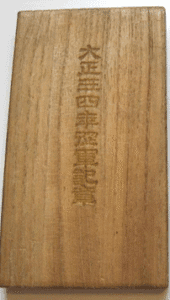
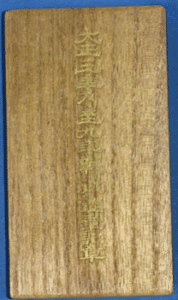
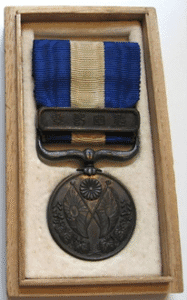
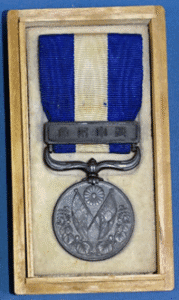
The box is made of wood. The gold kyūjitai inscription on the lid of the earlier type reads 大正三四年従軍記章 (Campaign Medal for Military Service in the 3rd to 4th Year of Taishō). The lid of the later type reads 大正三年内至九年戦役従軍記章 (Campaign Medal for Military Service from the 3rd to 9th Year of Taishō). The interiors of both boxes are lined with a white fabric. Each box originally included a protective sheet of washi paper.
| The Wooden box and the inside | |
| Wooden lid earlier type medal | Wooden lid late type medal |
 |  |
 |  |
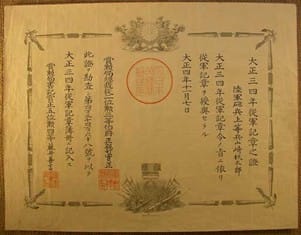
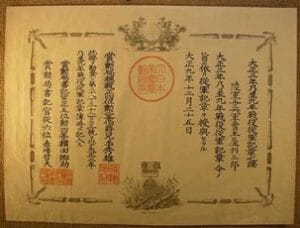
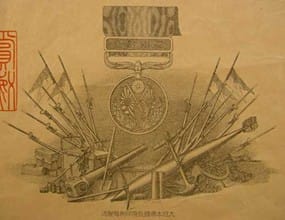
The medal is accompanied by a certificate. On this certificate, two different square stamps can be observed and one circular on the early type medal, and three different square stamps can be observed and one circular on the late type medal. The largest stamp reads: Seal of the Empire of Greater Japan. At the top of the certificate, the 16-petal Chrysanthemum Seal (kamon), the crest of the Japanese Imperial Household, is prominently displayed. On the bottom you see the First World War Medal, which makes it easy to identify that this certificate belongs to the medal. The certificate is shown in the image below.
| Earlier Type (The 8 Kanji on the right is identical to the box) |
 |
| Later Type(The 14 Kanji on the right is identical to the box) |
 |
| Both medals have an identical lower bottom part. |
 |
The following pictures will provide further details and explanations about the medal itself.
| On both medals the ribbon itself is white in the middle and blue on the sides | |
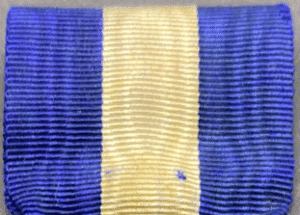 | |
| Both medals have the same suspension bar containing the kanji characters 従軍記章 which stands for Campaign Medal | |
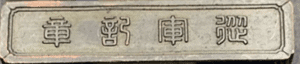 | |
| The obverse features two Japanese imperial flags crossed in the middle and the 16-petal Imperial Chrysanthemum kamon at the top. At the bottom you see two paulownia flowers to which the stems are tied | The reverse of the early type features the Inscription大正三四年戰役 (Taishō 3–4 Year Campaign) |
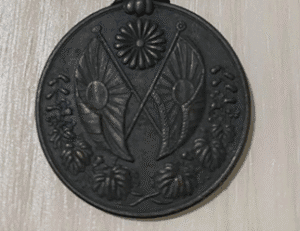 | 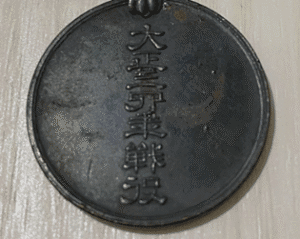 |
| The obverse is identical with the late type | The reverse of the Late type features the Inscription 大正三年至九年戰役 (Taishō 3rd to 9th Year Campaign) |
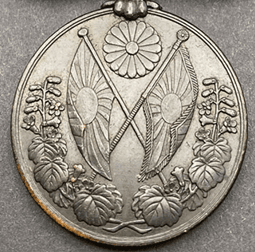 | 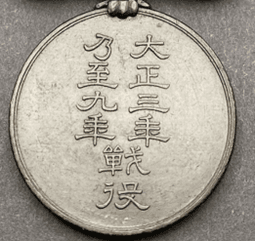 |
To conclude medal analysis: the characters of the medal and box are kyūjitai and the materials used are as follows: both medals itself are made of bronze (black patinated), with a diameter of 30mm and an approximate weight of 33 to 35g. The ribbon is made from woven silk and 36 mm wide. Also to be noted, this medal does not contain a certificate or washi paper.
The Inter Allied Victory Medal (Japan)
The second Taishō war medal is the Inter Allied Victory Medal. This medal was awarded to the allied powers who were victorious during the First World War. 15 different versions of this were made for 15 different nations, including Japan.
The medal was instituted on 17 september 1920 (Taishō 9 / 大正九年) by Imperial Edict No. 406. The medal has been minted in Japan mint, Osaka. Around 400.000 medals have been issued.
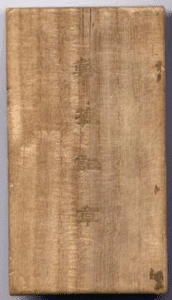
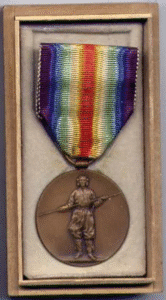
The box is made of wood. The gold kyūjitai inscription on the lid reads 戦捷記章 (Victory Commemorative Medal). The interior of the box are lined with a white fabric. The box originally included a protective sheet of washi paper.
| The wooden box and the inside | |
 |  |
The medal is accompanied by a certificate. On this certificate, four different stamps can be observed. The largest stamp reads: Seal of the Empire of Greater Japan. At the top of the certificate, the 16-petal Chrysanthemum Seal (kamon), the crest of the Japanese Imperial Household, is prominently displayed. On the bottom you see the The Inter Allied Victory Medal (Japan), which makes it easy to identify that this certificate belongs to the medal. The certificate is shown in the image below.
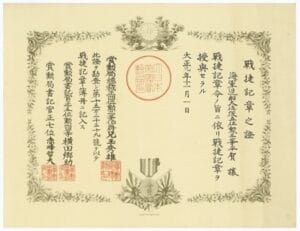 |
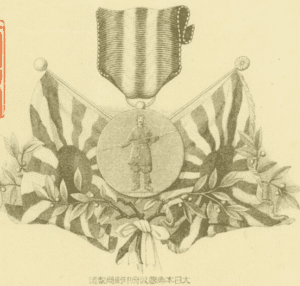 |
In the next following pictures further details and explanations will be provided about the medal itself.
| The ribbon itself is rainbow coloured | |
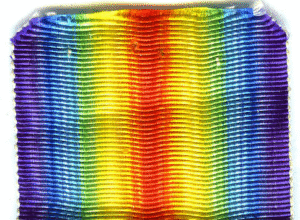 | |
| There is no suspension bar present | |
| —————————————————- | |
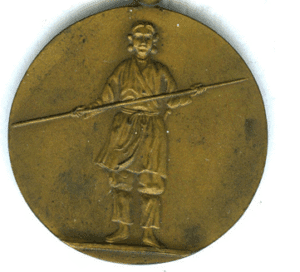
| The obverse features the Japanese war god Takemikazuchi (建御雷/武甕槌), in comparison to the European versions, where you see Roman gods. | The reverse features in the centre a globe with cherry blossoms and five ally flags, surrounded by inscription. The inscription reads clockwise as follows: 文明擁護の大戦 (The Great War for the Protection of Civilization), 自大正三年 (Vanaf Taishō 3), 同盟及び聯合国 (The Allies and Associated Powers), 至る大正九年 (Until Taishō 9) |
 | 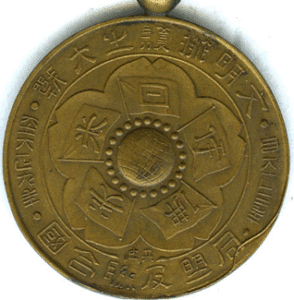 |
The reverse of the medal is inscribed using kyūjitai characters, which is an important detail for dating and authenticity. As for materials: the ribbon is made from woven silk and 37 mm wide. The medal is Bronze (light yellow alloy) and has a diameter of approximately 30 mm and weighs around 21,5 grams. To be noted: this medal does not contain a washi paper to protect the box.
The 1931-34 China Incident War Medal
The third medal is a Shōwa era medal. The 1931-34 China Incident War MedaI, came into existence after a false flag event (Mukden incident) set off by the Japanese in China (Manchuria). The Mukden Incident occurred on September 18, 1931, when the Japanese Kwantung Army blew up a railway line near Mukden (Shenyang) and falsely attributed the attack to Chinese troops as a pretext for invading Manchuria. The event led to the rapid occupation of Manchuria and the establishment of the Japanese puppet state of Manchukuo in 1932. International criticism followed, particularly from the League of Nations, but Japan ignored the criticism and withdrew from the organization in 1933, marking a break with the international legal system and Wilsonian ideology. This could be seen as the beginning of Japan’s aggressive expansion into Asia.
The medal was established by Imperial Edict No. 225 , issued on 23 July 1934 (Shōwa 9/ 昭和九年). It was produced at the Japan Mint in Osaka, private minters also produced them, although this was still under Japan Mint’s directions. Approximately 3.400.000 were minted, till 1940.
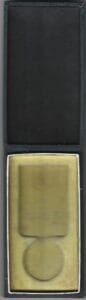
The box is made of die-cut cardboard with glossy varnish. The kyūjitai inscription on the lid reads 明昭和六年乃至九年事變従軍記章 (Shōwa 6–9 Incident War Medal), and the interior is lined in white. The box originally came with a protective sheet of washi paper.
| The carton box lid and the inside | |
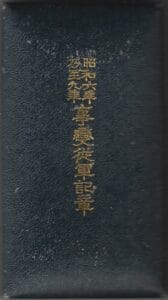 | 
|
The medal is accompanied by a certificate. On this certificate, two different square stamps can be observed and one circular. The largest stamp reads: Seal of the Empire of Greater Japan. At the top of the certificate, the 16-petal Chrysanthemum Seal (kamon), the crest of the Japanese Imperial Household, is prominently displayed. On the bottom you see the The 1931-34 China Incident War MedaI, which makes it easy to identify that this certificate belongs to the medal. The certificate is shown in the image below.
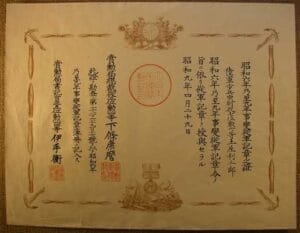 |
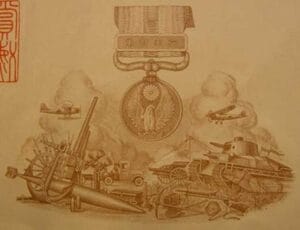 |
In the next following pictures further details and explanations will be provided about the medal itself.
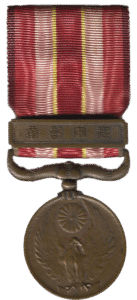
| The ribbon itself contains the colours from the outside to the inside; dark brown-red, bright orange, soft pink, yellow, bright red | |
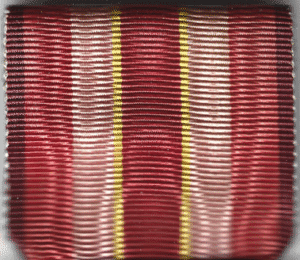 | |
| The suspension bar contains the kanji従軍記章(Campaign Service Medal) | |
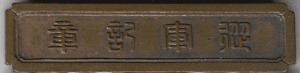 | |
| The obverse is a golden crowned crow, sitting on an ancient shield, with a radiant background and above it the 16-petal imperial chrysanthemum kamon. | The reverse Background of blooming cherry blossoms with the Japanese military helmets more in the front hanging above the, in the middle sitting text. |
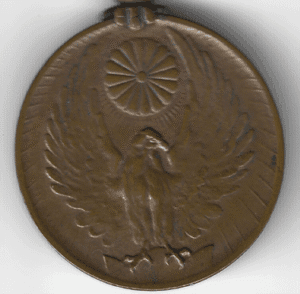 | 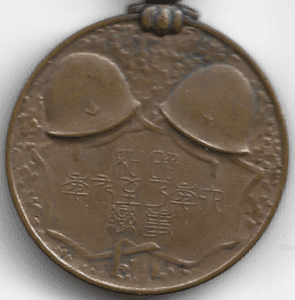 |
All kanji characters on the medal is inscribed using kyūjitai characters, which is an important detail for dating and authenticity. As for materials: the ribbon is made from woven silk and around 37 mm wide. The suspension bar and the medal are bronze. The medal has a diameter of approximately 30 mm and weighs around 30 grams.
The 1937-45 China Incident War Medal
The fourth medal is the 1937-45 China Incident War Medal. It was established after another false flag operation, called the Marco Polo bridge incident. To summarise the war; The China Incident was also called the Marco Polo Bridge Incident which happened on July the 7th7 1937. This marked the start of a full-scale war between Japan and China. It escalated into a prolonged and brutal conflict, with major battles such as the fall of Nanjing and widespread atrocities committed by Japanese forces. Though Japan did not formally declare war until 1941, the incident became a central front in the Second Sino-Japanese War and later merged into the broader context of World War II.
The medal was established by Imperial Edict No. 496, issued on 27th of July, 1939 (Shōwa 14/ 昭和十四年), and was produced at the Japan Mint in Osaka. Approximatly 3.400.000 were minted.
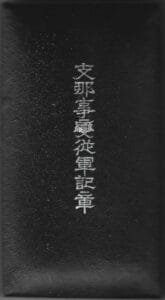
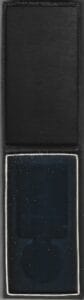
The box is made of die-cut cardboard with glossy varnish. The kyūjitai inscription on the lid reads China Incident Medal (支那事変従軍記章), and the interior is lined in dark blue. The box originally came with a protective sheet of washi paper, which can be seen below the box. From right to left the washi paper says: 授与証 (China Incident), 従軍記章 (Campaign Service Medal) and 造幣局製 (Mint Bureau Production).
| The carton box lid and the inside | |
 | 
|
| The washi paper | |
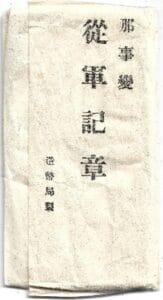 | |
The medal is accompanied by a certificate. On this certificate, two different square stamps can be observed and one circular. The largest stamp reads: Seal of the Empire of Greater Japan. At the top of the certificate, the 16-petal Chrysanthemum Seal (Kamon), the crest of the Japanese Imperial Household, is prominently displayed. On the bottom you see The 1937-45 China Incident War Medal, which makes it easy to identify that this certificate belongs to the medal. The certificate is shown in the image below.
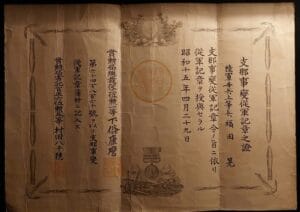 |
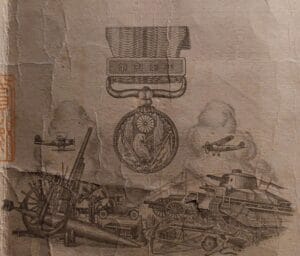 |
In the next following pictures further details and explanations will be provided about the medal itself.
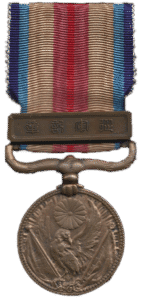
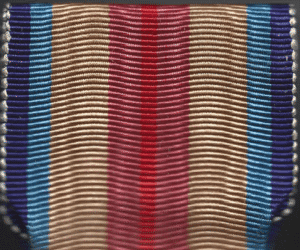
| The ribbon from the outside to the middle; darkpurple, light blue, orange-ocher yellow, pinkish red and red. | |
 | |
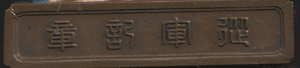
| The suspension bar contains the kanji従軍記章 (Campaign Service Medal). | |
 | |
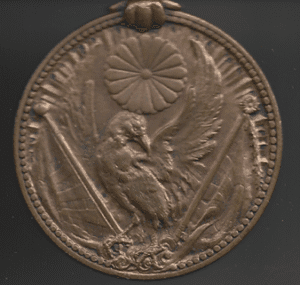
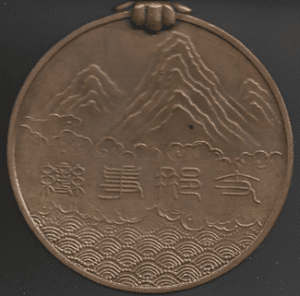
| The obverse features at the top the 16-petal Imperial Chrysanthemum kamon. In the middle golden crowned crow on two Japanese imperial flags crossed, with a radiant background. | The reverse mountains, clouds, waves with the writings支那事変 (China Incident) in the clouds. |
 |  |
All kanji characters on the medal is inscribed using kyūjitai characters, which is an important detail for dating and authenticity. As for materials: the ribbon is made from woven silk and around 37 mm wide. The suspension bar and the medal are bronze. The medal has a diameter of approximately 30 mm and weighs around 18-20 grams.
The 1941-45 Great East Asia War Medal
The fifth and final medal under the Shōwa period is the 1941–45 Great East Asia War Medal. This medal was intended to commemorate service during Japan’s broader Pacific War (1941–1945). Although envisioned as a widespread campaign decoration, severe wartime material shortages and Japan’s eventual defeat meant that only approximately 10,000 tin-alloy medals were produced—most of which were subsequently destroyed by Allied occupation forces before they could be distributed. As a result, this medal has become known as a rare “phantom” award, with only a handful of surviving examples. Due to their scarcity, original specimens typically range in price between €700 and €1,000.
The medal was officially established by Imperial Edict No. 417, issued on 21 June 1944 (Shōwa 19 / 昭和十九年), and was minted by the Japan Mint in Osaka. Although around 10,000 were struck, the post-war survival of the medal casts led to the creation of reproduction versions in the 1955 till 1965 by Japanese nationalist and veteran organisations.
In total, three post-war versions are known:
- The prototype version (rare, even among reproductions),
- The version bearing the inscription “Great East Asia War Medal” (大東亜戦争従軍記章) vertically on the reverse, this matches the format used in both the original medals and most early reproductions
- The 35th-anniversary commemorative version, created in the 80’s.
It is important to clarify that these are not forgeries. They are reproductions intended specifically for veterans, and while not officially awarded, they were legitimately produced for commemorative purposes. Hence, the designation “phantom medal” persists—original in intent, but never formally distributed. This is largely due to the fact that all war medals, including the prestigious Order of the Golden Kite, were abolished in 1945. So if the term official is used, in this context I mean the ones originally awarded in World War 2.
Because this medal involves a considerable degree of complexity and the available sources are quite varied, I have chosen to be as transparent as possible regarding the information presented here and its origins. The details provided about this medal are based on both the sources from which I obtained certain images (see Image Sources) and international/Japanese references (see 1941–45 Great East Asia War Medal Sources). In contrast, the other war medals and orders discussed in this guide are, in my opinion, far less complex. Their provenance and details can be more easily verified through widely accessible resources such as reputable websites or published (Japanese) literature.
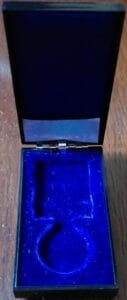
The original medal box may have been made from cardboard, although some rare examples were manufactured in black or red. The later reproductions came in plastic and wood, some bearing the imperial chrysanthemum kamon on the lid, as shown in the images below. The shinjitai inscription on the box reads Great East Asia War Medal (大東亜戦争従軍記章), and the interior is lined with dark blue fabric. Due to wartime shortages, the box did not include a washi paper or certificate. I have not been able to find the original box to show, but I do have the different boxes that were given for all versions. Although version 1 and 2, came in all three types of boxes after the war which can be seen in the following pictures. The one of the 35th-anniversary commemorative came only in the plastic one but with golden letters only.
| The plastic lid and the inside (cheaper version) | |
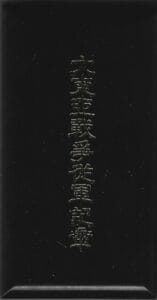 | 
|
| The wooden black box with the 16-petal Imperial Chrysanthemum kamon | |
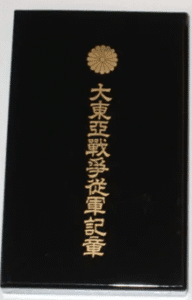 | 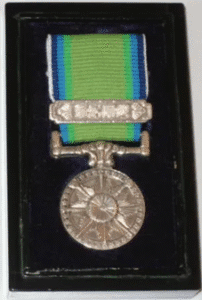 |
| The wooden box with only the inscription on the lid | |
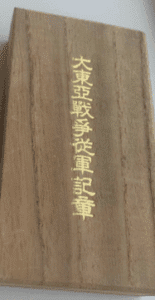 | 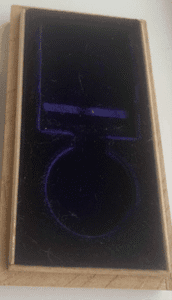 |
The kyūjitai on the box is for wartime medals, which makes it very difficult to date the medal to a certain era.
In the next following pictures further details and explanations will be provided about the medal itself.
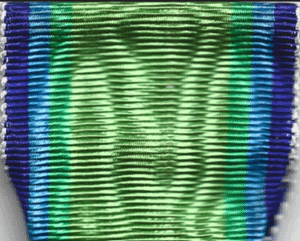
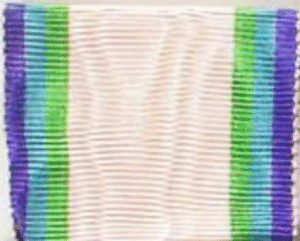
| The ribbon from the outside to the middle; dark violet blue, blue grey, vivid yellow-green and light yellow-green. This ribbon is only for the original, and reproduce version 1 and 2 |
 |
| This is the 35th-anniversary commemorative version. The ribbon from the outside to the middle; dark violet blue, blue grey, vivid yellow-green and white. |
 |
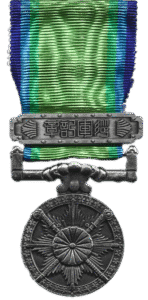
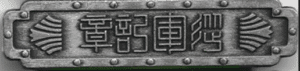
| The suspension bar contains the kanji従軍記章 (Campaign Service Medal). Which is similar to the official World War 2 medal. |
 |
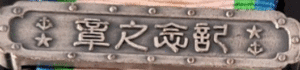
| This is the 35th-anniversary commemorative version, which also says従軍記章 (Campaign Service Medal), but has a star, an anchor on both sides. |
 |
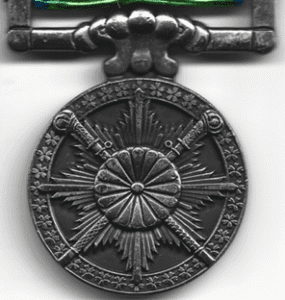
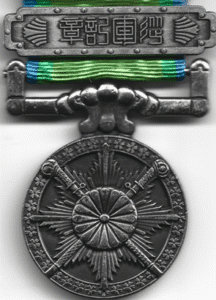
| The obverse Central you see the Imperial chrysanthemum coat of arms, crossed swords, ray motif and a ring of sakura leaves cast on top | The reverse of the first version, which is the prototype version and has nothing on the back. |
 | 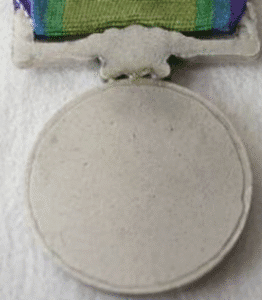 |
| Obverse is the same in all versions, | |
| The reverse of the second version, which is the common version and also part of the initial look for the official medal from World War 2. The characters vertically say: 大東亞戰爭 (Great East Asia War) | 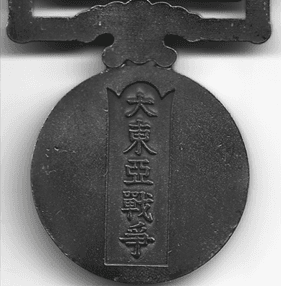 |
| The reverse of the Third version which is the commemorative medal. On top you see the characters大東亞戰爭 (Great East Asia War) and below the dates of昭和16年12月8日 (Shōwa 16 (1941), December 8) - 昭和20年8月15日 (Shōwa 20 (1945), August 15) Which are the dates of the attack on pearl harbor and the capitulation of Japan. | 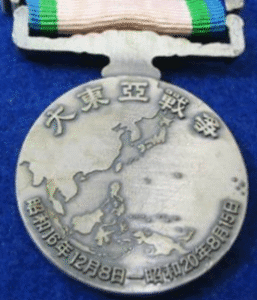 |
The difference between an official late world war 2 medal and a reproduce is as follows:
| The obverse of the medal is noticeably dull and lacks the shine seen on reproductions. Additionally, the front of the suspension bar on the official World War II version appears slightly less refined, particularly in the two graphic designs to the left and right of the kanji characters. In contrast, the modern version looks significantly cleaner and more sharply finished than the medal officially issued during the Second World War. | |
| The original obverse | The reproduction obverse |
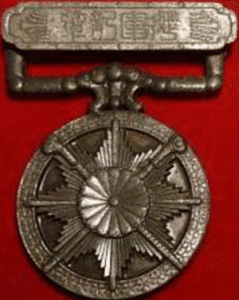 |  |
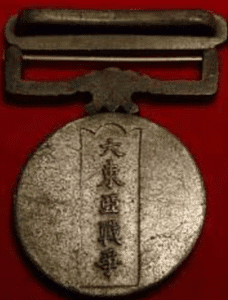
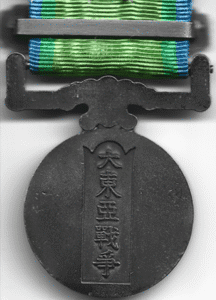
| As you can see, the reverse is just as dull and lacks the lustre seen on the obverse. It’s also noticeable that the official version shows more signs of age and wear. The kanji on both are in kyūjitai script, but the official version appears less sharply defined than the reproduction. That said, some reproductions can indeed feature the same kanji as the originals. In most cases, the box alone can help you date the medal. If the box is missing, pay close attention to the overall wear. Otherwise, your best clue is often the suspension bar, which reveals subtle differences. The official version’s suspension bar, especially on the reverse, is less sharply angled and lacks that ‘modern industrial’ precision. It’s a small detail, but crucial when distinguishing an official issue from a reproduction. | |
| The original reverse | The reproduction reverse |
 |  |
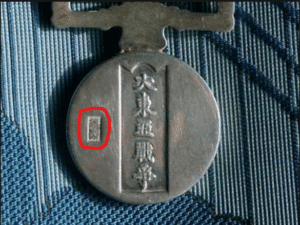
All kanji characters on the original and reproduce medals are inscribed using kyūjitai characters, which is an important detail. As for materials: the official ribbon is made from woven silk and the reproduction as made from a synthetic silk. Both ribbons are around 36 mm wide. The suspension bar and the medal are tin.* The medal has a diameter of approximately 30 mm and weighs around 22 grams.
| *Some medals are made out of silver and they will have a small stamp on the reverse next to the vertical text. |
 |
Japanese and international Sources about The 1941–45 Great East Asia War Medal
International source – https://gmic.co.uk/topic/84726-authentic-greater-east-asia-war-medal
International source – warrelics.eu, The Evolution of Imperial Japan’s War Medals. P3
Japanese source – https://kur0s1ba-wank0.com/warremains-of-japan/war-medal/daitoa-war
Japanese source – https://ja.wikipedia.org/wiki/従軍記章
Japanese source – https://www.digital.archives.go.jp/file/141923.html
Japanese source https://dl.ndl.go.jp/view/prepareDownload?contentNo=1&itemId=info%3Andljp%2Fpid%2F3192150
Japanese source – Japanese digital archive: https://shorturl.at/3jUGA
Image sources are from:
https://www.nambuworld.com/medals.htm
https://griffinmilitaria.com/product/boxed-japanese-1914-1920-war-medal/
https://www.warrelics.eu/forum/japanese-militaria/war-medals-337396/
https://www.ebay.com/itm/146688545959?_trksid=p2332490.c101196.m2219
https://www.liverpoolmedals.com/product/w-w-i-medal-1914-1920-siberian-intervention
https://gmic.co.uk/topic/3252-japanese-awards-ww1-victory-medal/
https://commons.wikimedia.org/wiki/File:Certificate_of_the_Interallied_Victory_Medal_of_WWI_for_Yuzuru_Hiraga_1920.jpg
https://en.wikipedia.org/wiki/Victory_Medal_(Japan)
https://www.warrelics.eu/forum/japanese-militaria/evolution-imperial-japana-s-war-medals-1875-1945-a-610821-3/
The 1941-45 Great East Asia War Medal, The 1937-45 China Incident War Medal, its certificate and The 1931-34 China Incident War Medal are from personal collection.

Written by Ritchie Davelaar,
Student historicus and
Japanese Militaria Expert