
The Order of the Sacred Treasure, A Comprehensive Guide for Collectors
The historical background of the Order.
The Order of the Sacred Treasure (瑞宝章, Zuihō-shō) is a Japanese Order of merit, established in 1888 by Emperor Meiji. Originally, the Order comprised eight classes; however, in 2003, the seventh and eighth classes were abolished. Initially awarded exclusively to men, the Order was made available to women in 1919. Each conferment also includes a certificate.*
To receive the Order, individuals must have rendered long-term service either in national or local government roles, or in certain non-governmental positions considered equivalent to public service, and must have demonstrated distinguished contributions. Notably, the Order of the Sacred Treasure is conferred upon members of the Japan Self-Defense Forces (JSDF), whereas the Order of the Rising Sun is not. This distinction arises because JSDF personnel no longer meet the military criteria required for the Order of the Rising Sun.
*You can purchase and match the certificates with the Order if they are not included. Do keep in mind these certificates contain a date of issue, so they can only be matched to the time period your Order belongs to, because your Order doesn’t have a date of issue on the medal or box.
The importance of recognizing and periodizing the kanji and its differences on lacquer boxes.
To identify the class of the Order indicated on the lacquer box in front of you, it is essential to recognize the Japanese numeral kanji characters. These characters are: 一 (one), 二 (two), 三 (three), 四 (four), 五 (five)*, 六 (six), 七 (seven), and 八 (eight).**
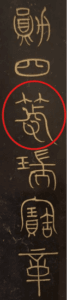
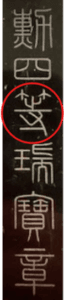
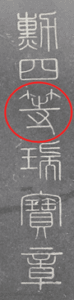
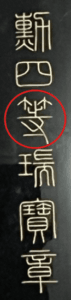
Periodization of the kanji can be determined by identifying the Japanese imperial reign periods, as reflected in the third kanji character on the lacquer box. This character not only changes in form depending on the era, but also in colour. The following examples uses the fourth class of the Order to illustrate these variations.
| Meji | Taishō and Shōwa | Shōwa | Shōwa and Heisei | Heisei and Reiwa |
| 1888 – 1912 | 1912 – 1940 | 1940 – 1945 | 1945 – 2003 | 2003 – Today |
| A complete different fond. Gold coloured | The ‘birds’ above the trident looking character are smaller. Gold coloured | The ‘birds’ above the trident looking character are smaller. Silver Coloured | The ‘birds’ above the trident looking character are bigger. Gold coloured | The third character is not present. Gold coloured |
 |  |  |  |  |
Recognising and periodising the kanji on the lacquer box is applicable to every Japanese order issued prior to 2003. Be mindful of transitional periods as well, since an early Taishō piece may resemble one from the late Meiji era. Although this is rare.
* On the lacquer box it looks like a hourglass
** The numbers are not visible anymore on The Order after 2003.
The rosettes by class and colour.
The rosettes and colours from 1888 to 2003 had a greyish tint with golden lines, as seen below.
 | First Class |
 | Second Class |
 | Third Class |
 | Fourth Class |
 | Fifth Class |
 | Sixth Class |
 | Seventh Class |
 | Eighth Class |
 | General ribbon of the order |
 | Grand Cordon |
 | Gold and Silver Star |
 | Gold Rays with Neck Ribbon |
 | Gold Rays with Rosette |
 | Gold and Silver Rays |
 | Silver Rays |
 | General ribbon of the order |
The rosettes and colours from 2003 to the present are dark blue, featuring the same gold detailing as those from the pre-2003 period.
Dating The Order of the Sacred treasure itself.
The order itself from 6th (六) till 1st (一) class, can be accurately dated by examining its reverse side. While the 8th (八) and 7th (七) class can only be dated by checking the top of the lacquer box.
Here are the examples on dating the reverse from 6th (六) till 1st (一) class:
| On the reverse, 4 bolts , from 1888 – 1945. |
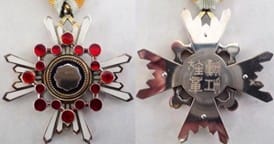 |
| On the reverse, smooth, attached with glue, from 1946 – 1990. |
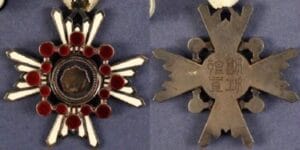 |
| On the reverse two screws, from 1990 – 2003. |
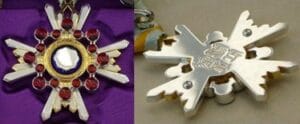 |
| On the reverse two screws. In general also has Paulownia leaves, 2003 – Today. |
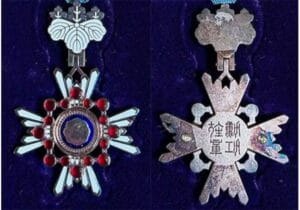 |
Markings on the Sacred Treasure.
Just like the German EK, Japanese orders are sometimes marked, although this is very rare. You can find the marking of the Order of the Sacred Treasure on the reverse side, encircled in the location shown in the following pictures.
40
| the 8th (八) and 7th (七)class | 6th (六) till 1st (一) |
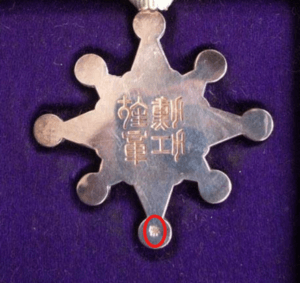 | 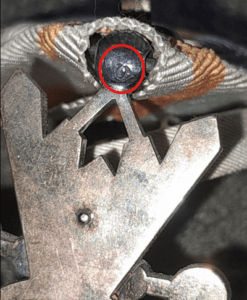 Or on the bottom of the reverse.
|
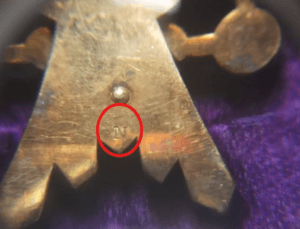
To identify the maker, I recommend:
https://asiamedals.info/threads/makers-marks-of-japanese-orders-and-medals.14996/
Written by Ritchie Davelaar,
Student historicus and
Japanese Militaria Expert